
Product Information
Tech Specs & Geometry
Dive into the exact dimensions, electronics, and engineering that make DreamPlay the world's first professionally-scaled ergonomic digital piano line.
Introducing the Sizes
Find your perfect fit.
Three DS Standard sizes — the same standard adopted by top universities worldwide. A professional instrument for every hand.
Standard Across All Models
The DreamPlay Foundation
Ergonomic DS Standard Sizing
Available in DS5.5 (7/8ths) and DS6.0 (15/16ths) sizes, matching the keyboard to your hand span and reducing stretching-related strain.
Authentic Weighted Keys
Every note responds to your touch with the dynamic range you'd expect from an acoustic piano, mapping perfectly to your muscle memory.
Interactive LED Learning System
Built-in key lights guide your fingers as you learn, seamlessly connecting with learning apps to accelerate your progress. Toggle them off for a classic look.
Professional Grade
All the Features You Need
Built-in Metronome
Recording & Playback
192-note Polyphony
Dual-Sensor Velocity Keys
MIDI Sequencing
18 Essential Presets
Backlit LCD Screen
Grand Piano Sound
Hi-Fi Speakers & Audio
88 Weighted Keys
Bluetooth Connectivity
LED Lighting For Every Key
Our Features
Everything You Need, Built In
Hover overTap a feature to learn more
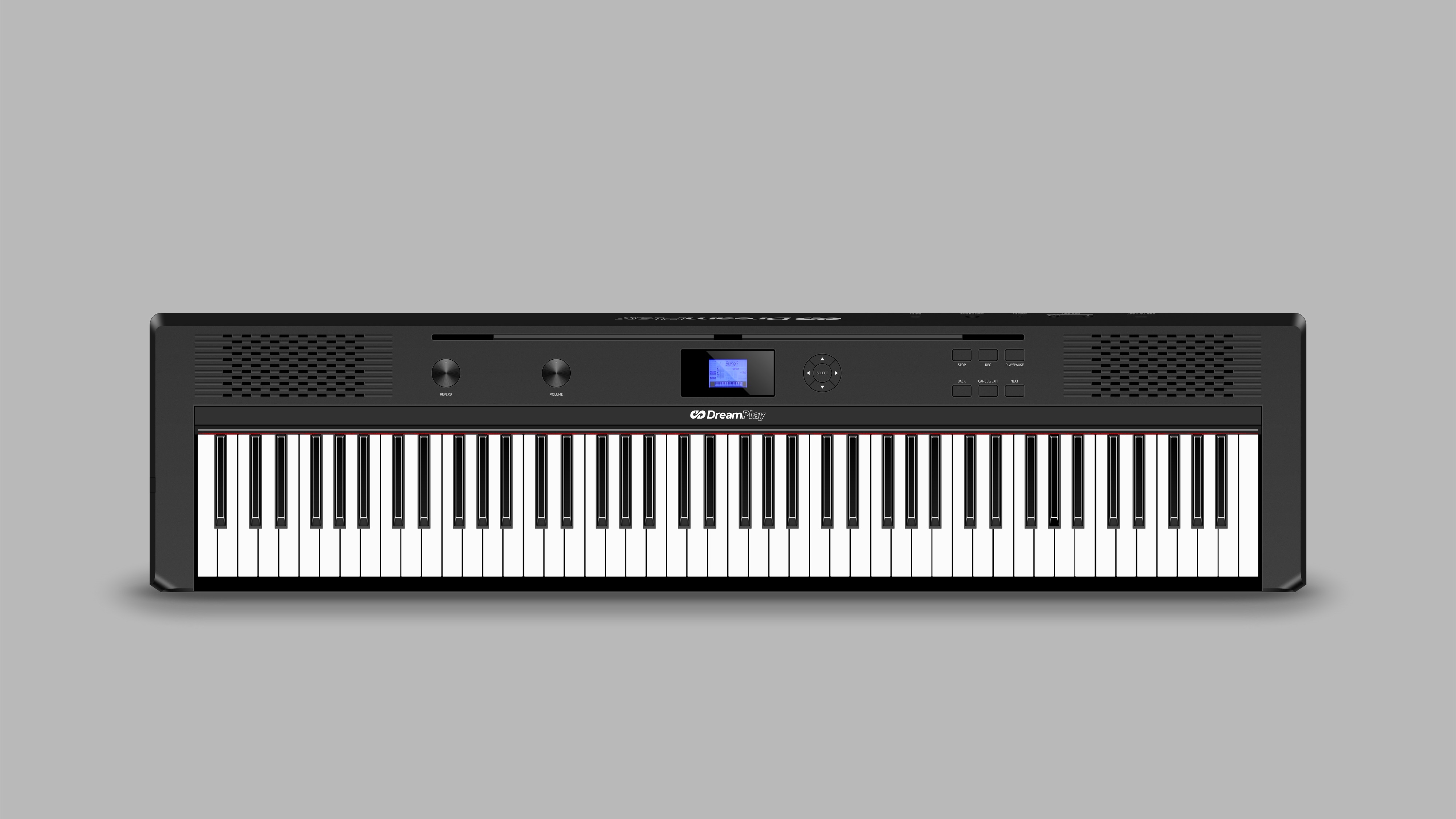
Select a feature above
Technical Details
Built without compromise.
The Science of Fit
Advanced Ergonomic Geometry
Most manufacturers hide their exact key dimensions. We publish ours openly because we engineered them down to the micrometer specifically for your hands.
The "Forgiveness Funnel" vs. The "Elevator Shaft"
Take a close look at a standard acoustic piano. The black keys aren't straight blocks; they are shaped like pyramids with a heavy outward slope (a 6.48° draft angle) towards the base.
This traditional shape acts as a "forgiveness funnel." When small-handed pianists stretch to reach large chords, their fingers naturally splay out and flatten, striking the keys at a severe diagonal angle. The heavy slant acts as a funnel to catch sloppy, angled finger strikes. But this design severely chokes the physical space available for your fingers at the bottom of the keybed. The slanted key is essentially a band-aid for an ergonomic problem caused by the piano itself.
David Steinbuhler, creator of the DS Standard, engineered a brilliant solution for the narrower sizes: he practically eliminated the taper. On the DS5.5 and DS6.0, the black keys feature nearly vertical walls. The DS5.5 features a virtually invisible 0.83° slope, acting like an "elevator shaft."
The Biomechanical Paradox
Because the octave is perfectly matched to your hand, you no longer have to stretch. Your hands stay relaxed in a proper "dome" shape, allowing your fingers to descend perfectly vertically. You don't need a forgiving funnel anymore!
By standing the walls up straight, we preserve an incredibly spacious playing gap between the black keys.
The Result: Despite being a much smaller keyboard overall, the physical gap where your fingers depress the keys on our narrower sizes is actually widerthan the gap on a full-sized 6.5" acoustic piano!
White Key Dimensions
The foundational spacing of the octave.
Black Key Dimensions
Engineered for perfect finger clearance utilizing near-vertical sidewalls.
* Key draft angle and gaps are calculated based on an estimated 0.52 to 0.57 inch exposed black key height.
Chassis & Footprint
The exterior dimensions of the instrument.
* Note: Both the DreamPlay One and the upcoming DreamPlay One Pro utilize the exact same exterior chassis structure, providing a sleek, unified footprint. The Pro model includes upgraded internal components such as larger 40W speakers and a Triple-Sensor action.
Head to Head
Model Hardware Specifications
* The DreamPlay One Pro is currently in active development. Pricing and hardware specifications are subject to slight changes before mass production.
Audio
Speaker System
I/O
Connectivity
Market Comparison
How We Stack Up
We engineered the DreamPlay series to go toe-to-toe with the world's leading standard-sized digital pianos, while destroying the narrow-key competition on price.
The Entry-Level Clash
Comparing the standard base models.
The Pro-Level Clash
Comparing the premium upgraded models.
The Narrow-Key Industry
Why pay double for retrofitted parts when you can get custom tooling?
Get Started
Ready to play without limits?
MSRP $1,499 — Founder's pricing available for a limited time.